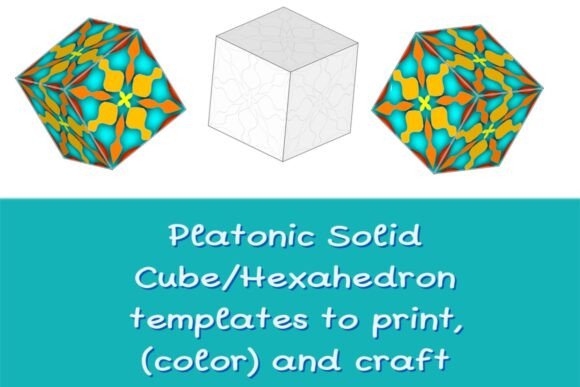
Printable Cube Template: A Hands-On Tool for Mastering Geometry
For many, mathematics remains a world of abstract formulas and distant concepts. Words like volume, surface area, and Platonic solids can feel disconnected from tangible reality. This is where the Printable Cube Template becomes a powerful bridge. It is a practical, downloadable resource providing a paper pattern for crafting a perfect cube, or hexahedron. By transforming a flat sheet into a three-dimensional object, it turns theoretical geometry into a physical experience, making learning interactive, memorable, and creative.
The Challenge of Abstract Geometric Concepts
Whether you are an educator, a parent supporting a child's learning, a student grappling with spatial reasoning, or an adult simply looking to re-engage with foundational ideas, visualizing 3D space can be difficult. Textbooks and diagrams offer a static view. Calculating the surface area of a cube using 6a² is a rote exercise unless you can truly see and touch those six identical squares. Understanding why a cube is one of the five Platonic solids requires more than a definition; it requires an appreciation of its perfect symmetry and regularity. This gap between theory and perception is a common hurdle. The goal is to move beyond passive learning to active understanding, where geometric principles are internalized through direct manipulation and observation.
How Printable Cube Template Addresses These Needs
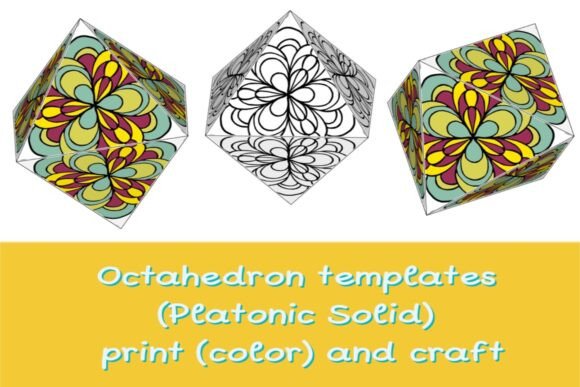
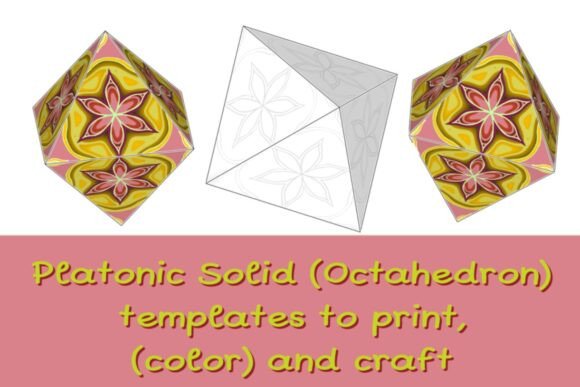
The Printable Cube Template directly tackles this by providing the blueprint for a hands-on experiment. Typically, you receive a zip file containing two PDFs optimized for printing. The first template often features a grey and white seamless pattern—a blank canvas awaiting your personalization. You can color it, label its faces, or annotate its edges, tailoring it to your specific lesson or project. The second template is usually pre-colored and ready for immediate use: cut, fold, and assemble. This immediate transition from a 2D net to a 3D solid is the core educational moment. As you craft the cube, you witness the relationship between the flat pattern and the final form. You physically count its faces, trace its edges, and measure its vertices. The abstract becomes concrete.
Practical Applications and Creative Outcomes
The utility of a Printable Cube Template extends far beyond a single crafting session. For educators, it is a springboard for dynamic lessons. Students can assemble their cubes, then calculate their own real-world surface area and volume based on the template's dimensions. They can compare the cube to other printed Platonic solids, exploring why each is unique. For parents and homeschoolers, it transforms homework into a fun, family-friendly activity. For adults, it can be a tool for creative problem-solving, model-making, or even a stress-relieving craft that subtly reinforces spatial skills.
Consider these specific applications:
- Visualizing Formulas: Label each square face with its area. Assemble the cube and see how the total becomes the surface area.
- Exploring Nets: Use the colored template to understand that a 3D shape can have multiple flat "nets" or patterns.
- Art and Design Integration: Decorate the grey-and-white template with patterns, flora illustrations, or thematic artwork, creating a unique geometric art object.
- Practical Exercises: Challenge users to determine the dimensions of the cube from the printed net, or to calculate how much larger a cube's volume would be if the template was scaled up by a factor of two.
Tailoring the Experience to Different Users
The flexible nature of the Printable Cube Template means it can be approached differently based on need. The educator might focus on the blank template, integrating the coloring phase into a lesson on symmetry or face identification. The busy parent might prefer the pre-colored PDF for a quick, successful project that yields an immediate result and a sense of accomplishment. A student might use both: one for a structured assignment and the other for personal experimentation. An artist or designer might see the grey-and-white pattern as a base for sophisticated pattern work, using the cube as a modular element in a larger installation. The common thread is the move from passive reception to active creation, which deepens understanding and retention.
Recommendations for Effective Implementation
To maximize the benefit of your Printable Cube Template, a few practical considerations are key. First, ensure you have quality paper for printing; a slightly heavier stock or cardstock will yield a more durable and satisfying final cube. Secondly, precision in cutting and folding is important—clean edges and sharp folds make assembly easier and the geometric properties clearer. Use the assembly process itself as a learning opportunity: discuss the role of tabs and glue flaps in constructing 3D models from 2D materials. Finally, don't stop at one cube. Creating multiple cubes allows for exploration of stacking, spatial arrangement, and more complex volume calculations. The template is a starting point, not an endpoint.
From Template to Tangible Understanding
The ultimate outcome of using a Printable Cube Template is a shift in how geometry is perceived. It ceases to be a collection of formulas and becomes a language describing real objects you can hold. The concepts of face, edge, and vertex are no longer memorized definitions but experienced facts. The calculation of volume evolves from an algebraic task into a question about the space inside an object you built. This hands-on methodology aligns with proven pedagogical approaches that emphasize kinesthetic learning. By investing a little time in cutting, folding, and crafting, you gain a profound and lasting insight into the fundamentals of three-dimensional space.
Whether your aim is to enhance a classroom, support learning at home, satisfy a personal creative itch, or simply bring a tangible, fun element into the world of mathematics, the Printable Cube Template provides an elegant solution. It is a resource that empowers you to create, explore, and ultimately understand. So download your templates, print them, and start folding. The world of geometry is waiting for you to bring it to life.